
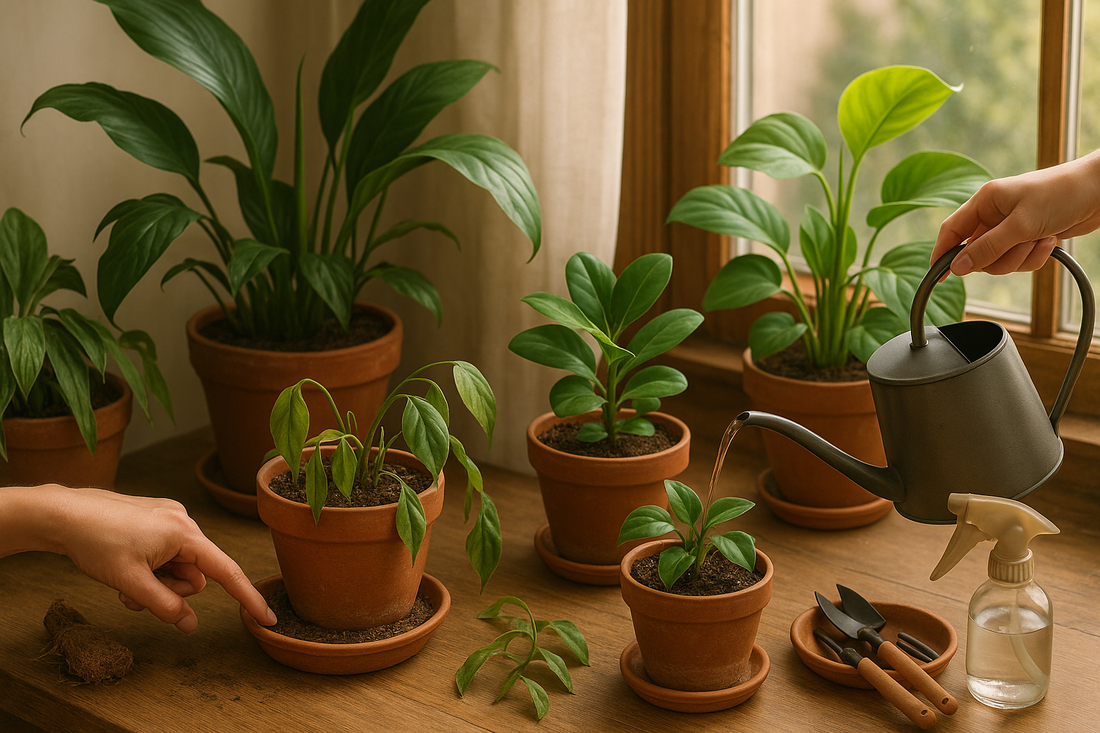
Caring for and Saving Houseplants After Your Vacation: First Aid for Dehydrated Friends
Share
Vacation is relaxation for us – but often stressful for our green housemates.
Good preparation for your absence is always helpful (see also our blog post: Summer Vacation! How Your Houseplants Survive Your Absence) Depending on how you prepared your green friends, or perhaps hired someone to plant-sit, the condition of your plants will vary upon your return.
Should you find drooping leaves, dry soil, or brown tips, don't worry: Many plants can be revived with the right care.
In this article, you will learn how to provide 'first aid' to your green housemates after your vacation.
🪴 Step 1: Damage Check
Before reaching for the watering can, examine the plant carefully:
- Leaves -> are they yellow, brown, or just limp?
- Soil -> Completely dried out or still slightly moist?
- Roots -> If visible (for this, clear pots are worth their weight in gold), do they look healthy (white) or mushy (brown/black)?
💧 Step 2: Correct Watering
The biggest temptation is to immediately overwater the plant with a lot of water. But be careful: Your houseplant should not be watered abruptly after your vacation. Proceed gently, otherwise, it can lead to root rot.
- Slightly dried out -> Water slowly in small portions.
- Completely dried out -> Place your plant in a bowl of water. Here, the soil can soak up water for 30–60 minutes, as needed. Then let it drain well.
- Avoid waterlogging -> Make sure no water remains permanently in the cachepot.
🌱 Step 3: Adjust Care According to Plant Type
- Succulents & Cacti -> Water less, gradually introduce moisture.
- Tropical plants (e.g., Monstera, Alocasia) -> Restore high humidity, mist leaves with water (temporarily), for constant humidity you can set up a humidifier.
- Flowering plants -> Remove withered parts so the plant can put its energy into recovery.
✂️ Step 4: Pruning
Cut off dried or mushy leaves and shoots. This saves the plant energy and allows it to focus on healthy parts.
🌬 Step 5: Optimize Location & Climate
- Place in semi-shade -> Do not place weakened plants directly in the sun.
- High humidity -> Especially important after heatwaves – e.g., using bowls of water or a humidifier.
- Allow to rest -> No immediate fertilization – wait 3–4 weeks until the plant has recovered.
🚑 First Aid for Specific Problems
- Dried soil that repels water -> carefully loosen with a fork or submerge the root ball in water.
- Pest infestation (e.g., fungus gnats, spider mites, thrips) -> Check immediately and treat accordingly.
- Brown tips -> Often a sign of dryness or low humidity.
- Mushy roots -> take your plant out of the substrate and remove all mushy and affected roots. Then replant it in fresh substrate in the same (cleaned) pot or a new one.
Tip: A clear pot is useful here so you can easily observe the roots. Place the plant in a bright spot, but not in direct sunlight, water only when the top layer of soil is dry, and observe whether new healthy shoots or roots develop despite possible leaf loss.
🚀 Conclusion
After your vacation, your plants might look a bit worse for wear – but in most cases, they can be saved. With patience, careful watering, some pruning, and the right climate, your green housemates will recover.