
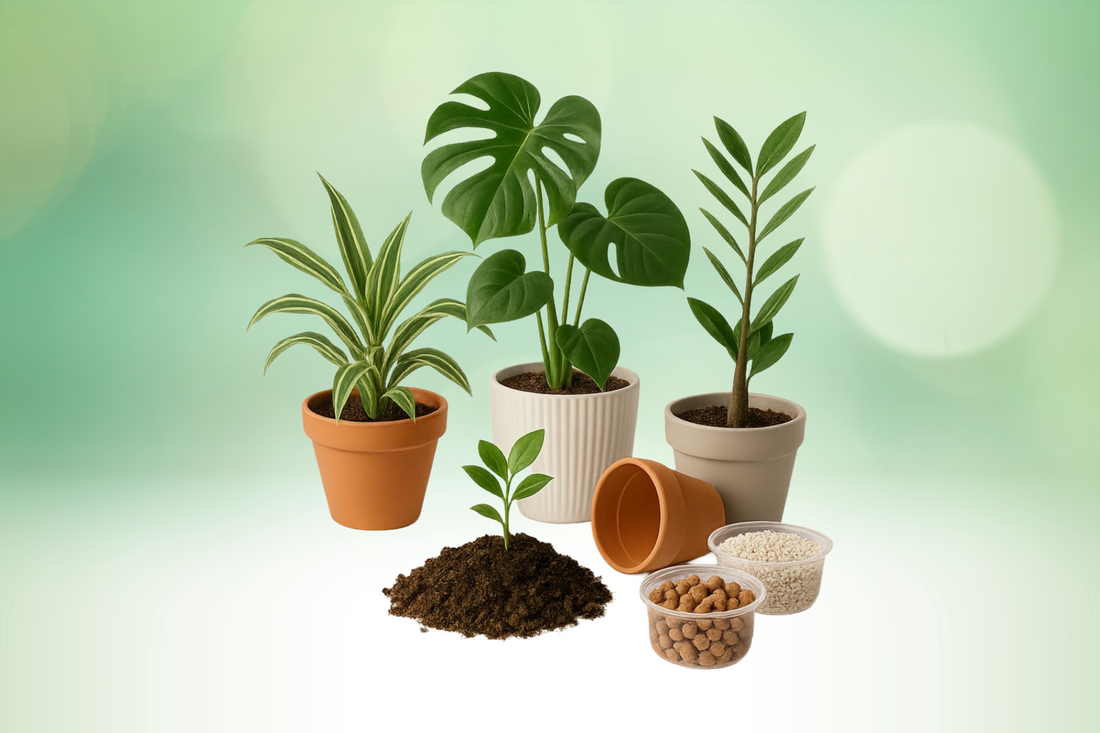
Repotting & Substrates: Soil, Mixtures, and Hydroponics Compared
Share
If you want to keep your houseplants healthy for a long time, you shouldn't just focus on proper watering and choosing the right location - the right substrate also plays a central role. In addition to classic potting soil, there are also numerous alternatives such as coir, perlite, moss, and various hydroponic systems like expanded clay, pon, and Seramis.
In this article, you'll learn about the available options and how to choose the right substrate for your plants.
🌱 Why the right substrate is so important
The substrate is not just the holding medium for your plant's roots - it influences water balance, air circulation, and nutrient supply. With the wrong substrate, problems like waterlogging, root rot, or stunted growth can quickly occur. With the right mix, you can optimally meet your plants' needs.
🪴 Classic Substrates and Additives
Universal Soil
• Suitable for many houseplants. Especially easy-care green friends.
• Contains humus and is often pre-fertilized.
• Good for easy-care plants such as dragon tree or rubber plant.
Cactus soil: Very permeable, high sand and mineral content, perfect for succulents.
Orchid substrate: Coarse and usually with pine bark, so the roots get plenty of air.
Palm soil: A little looser, stores moisture, but prevents waterlogging.
Coir
• Sustainable alternative, as it is made from coconut fibers.
• Loose, airy, and stores water without causing waterlogging.
• However, it contains no nutrients. (Regular fertilization required)
• Very fine structure -> can be too dense as a sole soil for some of your plants. It's better to mix coir with other substrate components to create an optimal and loose substrate for your plant.
Perlite
• White volcanic rock in pellets.
• Ensures permeability, aeration, and prevents compaction due to its light and porous structure.
• Stores water and releases it quickly, making it particularly good for plants that are sensitive to waterlogging.
• Suitable for propagating/rooting cuttings, plantlets, etc.
• For your adult plant, however, as an additive for your individual substrate
Moss (Sphagnum moss)
• Keeps moisture constant, is air-permeable at the same time, and promotes healthy root formation
• Very popular for propagating cuttings.
• For young plants and cuttings, it can be sufficient as a sole substrate (here, however, ensure adequate nutrient supply by adding fertilizer to the watering water carefully and in moderation)
• Not suitable as a permanent substrate for your houseplant
• Also make sure it is not too wet and tightly packed
🌿 Hydroponics: Expanded clay, Pon, and Seramis compared
In addition to classic soil, there is the option of growing houseplants in hydroponics. Here, the roots do not grow in soil, but in an inorganic substrate that stores water and allows air to reach the roots.
Your plants then grow, for example, in clay pellets instead of soil. With this type of substrate, a water level indicator in a self-watering pot is ideal, which shows you when your plant needs to be watered again.
Mineral substrate is particularly suitable for rarities, sensitive plants, or succulents because it is very airy, prevents waterlogging, and remains structurally stable long-term. It reduces problems like root rot and fungus gnats but requires consistent nutrient supply through regular fertilization. Ideal if you want full control over your plant's water and nutrients.
Below, we explain the different components:
Expanded clay
• Small, fired clay pellets.
• Very durable, dimensionally stable, and mold-resistant.
• pH neutral and almost nutrient-free (regular fertilization required)
• Advantage: Fewer pests (e.g., no fungus gnats).
Pon
• Mineral substrate made of pumice, zeolite, and lava. (Proportions may vary depending on the manufacturer. You can also mix your own substrate to adjust the proportions to your needs)
• Stores water and nutrients evenly.
• Often contains additional fertilizer pellets, which means your plants get a lot of nutrients with each watering (However, after a few months, the fertilizer effect decreases, and nutrients must be supplied through hydroponic fertilizer)
• Advantage: Very easy to care for, even moisture release.
Seramis
• Fine, porous clay granules.
• Stores a lot of water and releases it slowly.
• Ideal for plants that like consistent moisture.
• Advantage: Very good water and nutrient storage, easy to use.
• Disadvantage: Can easily remain too wet with overwatering and promote root rot.
🪴 Step-by-step repotting into soil or hydroponics
1. Prepare the plant: Gently remove old soil from the roots. Trim off any rotten or mushy roots. (When transferring to hydroponics, rinse roots thoroughly and remove organic soil material)
2. Choose a pot: Always choose a pot with a drainage hole or, for hydroponics, a pot with a water level indicator.
3. Create drainage (for soil): Add a layer of expanded clay or gravel about a hand's width at the bottom to prevent waterlogging.
4. Choose substrate: Mix soil with perlite/coir or switch directly to expanded clay, pon, or Seramis.
5. Plant: Place the plant in the center, fill with substrate, and gently press down. Gently "shake" if necessary to prevent air pockets.
6. Water: Lightly moisten the soil, water hydroponics according to the water level indicator.
💡 Pro tips
• Tropical plants like loose mixes with coir and perlite.
• Succulents prefer mineral additives like sand or pumice.
• For hydroponics, always use the correct fertilizer (specifically suitable for hydroponics).
• Pon is particularly suitable for people who prefer consistent watering to have a precise overview of water requirements.
• Seramis is ideal for plants that like constant moisture, e.g., ferns.
Conclusion
Whether classic soil with perlite or coir, or modern hydroponics with expanded clay, pon, or Seramis – the right substrate determines whether your plant merely survives or truly thrives. With the appropriate medium, you lay the foundation for your green companions to grow healthy, strong, and beautiful long-term.
💡🪴
Feel free to visit our website. Under "Substrates, Fertilizers & Plant Protection" you will find a selection of different substrates (from SYBotanica). Or our SUStee moisture meters and our Holo self-watering pot.